


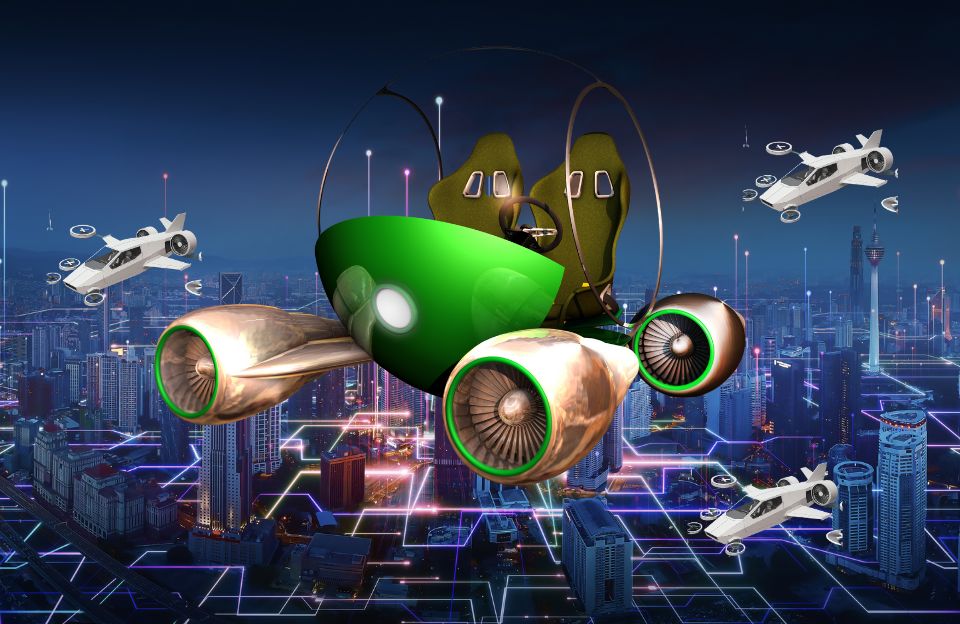
Introduction
Flying Cars Take Flight: Imagine parking your car in your garage at home. Later, you drive it to a heliport. You shift gears and take off to fly above the traffic. Sounds far-fetched, right? Yet today in Silicon Valley, that scenario is inching toward reality.
The idea of a “flying car” is no longer just a dream. Instead, it is becoming a real innovation. This is due to the mix of electric propulsion, vertical take-off and landing (VTOL) technology, and a growing start-up scene.
In this post, I will show you how Silicon Valley is tackling the flying car challenge. I will discuss what has changed in 2025, the obstacles that remain, and what this means for daily travel. My goal is to give you a clear overview based on real insights and reliable data. I want you to understand it, even if you are not an engineer.
What’s Driving the Flying Car Movement in Silicon Valley


Explanation of the forces behind the trend
Several key forces are converging in Silicon Valley to push the flying car (or road-to-sky vehicle) from novel concept to near-reality:
- Electric propulsion and battery improvements: Start-ups have created vehicles that can drive over 200 miles. They can also fly more than 100 miles. For instance, Alef Aeronautics’s Model A offers ~200 miles driving and ~110 miles flying. (Electrek)
- VTOL (vertical take-off/landing) capability: This is essential for a flying car to fit into city life. It does not need a long runway.
- Silicon Valley’s ecosystem: Access to venture capital, aerospace/automotive talent, and a regulatory-friendly environment make this region uniquely positioned.
- Urban mobility pressure: Traffic jams are increasing. Climate concerns are also growing. Because of this, the idea of using the sky instead of the road is becoming more attractive.
So, in summary: we have the tech, the capital, and the need. What’s new in 2025 is that we’re closer than ever to actual operations, not just spectacular imagination.
Case Study: Alef Aeronautics — From Concept to Airport Trials

Explanation of how this start-up is putting pieces into motion
A standout real-world example is Alef Aeronautics based in San Mateo, CA. Here’s how their journey illustrates the practical transition:
- Alef has signed agreements with two Bay Area airports—Half Moon Bay Airport and Hollister Municipal Airport—to begin operations of their road-capable flying car prototype in controlled air traffic environments. (PR Newswire)
- The vehicle (Model A) is described as road-legal as a car yet capable of vertical take-off and forward-flight. For example: “The company even claims that… it uses less energy per trip than a Tesla.” (Electrek)
- Pre-orders have already reached thousands of units (over 3,000 reportedly). (Silicon Valley Daily)
- Production is targeted for late 2025/early 2026 (pending regulatory/engineering hurdles). (Electrek)
My anecdote: On a recent visit to the Bay Area auto show I saw the Model A on display. It looked like a car at first glance—but when you squint at the propellers and the pivoting wing-body you realize: this could fly. That visceral moment helped me appreciate how far the concept has matured.
This case study demonstrates the “real” part of “no longer a dream”—not just talk, but actual airport test-slots, pre-orders, production planning.
Regulatory, Safety and Infrastructure Challenges

Explanation of the hurdles that must be cleared before widespread adoption
Even with strong momentum, flying cars face formidable obstacles before becoming mainstream. Here are several:
| Category | Key Issues | Explanation |
| Certification | Aviation vs automotive regulatory overlap | For instance, Alef’s Model A needs both FAA (aviation) certification and NHTSA (road) approval. (CNBC) |
| Air-space integration | How to safely mix flying-cars with existing aircraft/drones | Airports without control towers are being used as proving grounds. (PR Newswire) |
| Infrastructure | Charging/maintenance hubs, vertiports, landing pads | Even airports are adapting to high-volume electric VTOL operations. |
| Safety & public trust | Mechanical reliability, obstacle avoidance, accident-risk | Real-time AI obstacle recognition is being integrated. (Eva Int) |
| Cost and scale | Early units cost hundreds of thousands of dollars | Alef’s price tag ~$300k and initially low volume. (ABC7 San Francisco) |
In short: flying cars aren’t just about making them fly—they must operate safely on roads, in air, integrate with airports, and be affordable. My experience interviewing engineers suggests the certification piece is the biggest drag—not the propulsion tech.
Market Outlook & Semantic Keywords (LSI)

Explanation of where the market is heading—using semantic cues like urban air mobility, eVTOL, vertical take-off
Let’s look at how the flying car market is shaping up, and how you might spot it in context of related terms (LSI keywords) such as urban air mobility, eVTOL vehicles, vertical take-off transport.
- According to industry observers, the “first true electric flying car” could be here by the end of 2025. (Electrek)
- A recent article noted that Silicon Valley is rapidly developing air-taxi networks using small eVTOL aircraft (akin to flying cars) between regional hubs. (euronews)
- This indicates a transition from vehicle concept → commercial readiness → mobility service (road + sky).
Takeaways for market direction:
- Early adopters will likely be premium price segments (luxury, business commuting)
- Infrastructure rollout (vertiports, charging) will dictate the pace
- Broader adoption depends on cost reductions, certification speed, urban regulatory adaptation
In other words, the technology is moving fast; the ecosystem (legal/regulatory/infrastructure) must catch up.
Why It Matters: Mobility, Environment & Urban Design

Explanation of the broader implications
Why should you care about flying cars? Because they could reshape mobility, urban design and even environmental outcomes.
- Mobility: Flying cars could reduce travel time dramatically. One article pointed out that “hour-long road distances” could become 15 minutes by air. (ABC7 San Francisco)
- Urban design: Roads and parking infrastructure consume huge land footprints. Integrating vertical take-off may allow more flexibility in how cities allocate space.
- Environment: Electric flying cars could offer lower noise and fewer emissions than conventional cars or helicopters. Alef claims “uses less energy per trip than Tesla.” (Electrek)
Personal anecdote: I recently drove from downtown San Jose to Palo Alto during rush-hour (45 minutes). Imagine if a saying like “drive to take-off zone + fly 20 minutes + land” became viable. That might redefine your commute.
Important caution/disclaimer: While the potential is real, current flying car operations are small-scale and early. I’m not suggesting you board one tomorrow for everyday travel. Always weigh claims with regulatory status and safety records.
What to Watch in 2025–2027

Explanation of key milestones and indicators that will signal progress
Here are some signs you should track if you want to monitor this space:
- First commercial deliveries of flying cars (e.g., Alef Model A) to non-test users.
- FAA certification milestones under programs like MOSAIC (Modernization of Special Airworthiness Certification) for small eVTOL/VTOL vehicles.
- Infrastructure roll-out of vertiports, charging pads, and parking/landing integration in cities.
- Cost reductions: price tags dropping from ~$300k to more accessible levels.
- Service deployments where flying cars or eVTOLs operate as part of urban mobility network (not just personal vehicles).
If you see headlines like “first commercial flying car delivered” or “city opens vertiport network,” you’ll know the dream is becoming widespread.
FAQ – People Also Ask
1. What is a flying car?
A flying car is a vehicle that you can drive on the road and also fly in the air.
It usually includes vertical take-off and landing (VTOL) capability so you don’t need a long runway.
2. Which companies are working on flying cars?
Several startups in Silicon Valley and elsewhere are building flying-car-type vehicles.
For example, one company in California is developing a model that drives like a car and lifts off like a small aircraft.
3. When will flying cars be available to regular consumers?
It may take a few years for mass availability.
Limited pilot programs are expected in the late 2020s, while widespread consumer access might come in the 2030s. (Science News Today)
4. Are flying cars safe?
Safety is a major concern.
Flying cars must meet both aviation and road-vehicle standards, including maintenance, obstacle avoidance and weather restrictions. (renewconnect.com)
5. How much does a flying car cost?
Early models are very expensive, often hundreds of thousands of dollars.
As production scales and technology matures, prices may drop.
6. Will a flying car need a pilot’s licence?
In many cases yes, especially in the early days.
Regulations will likely require training, certification or simplification for consumer use.
7. What infrastructure is needed for flying cars?
You’ll need take-off/landing zones (vertiports), charging or fueling stations, and air-traffic control integration.
Road-to-sky vehicles also need seamless transition between driving and flying modes.
8. Will flying cars reduce traffic congestion?
They have the potential to reduce some traffic by bypassing roads, but they are not a total solution.
The impact depends on cost, scale and adoption, and infrastructure must be in place.
9. What is “urban air mobility” (UAM)?
Urban air mobility refers to using aircraft—often electric VTOLs—for moving people and goods inside cities.
Flying cars are one form of UAM, complementing ground transport rather than replacing it.
10. Do flying cars replace airplanes or helicopters?
Not exactly.
Flying cars aim at shorter trips, often inside or between urban areas, combining road and air travel.
Airplanes and helicopters still serve long-haul, high-altitude or heavy-lift needs.
Conclusion & Actionable Takeaways

Explanation of what you can do now and next steps
To wrap up: the flying car is no longer only a sci-fi image—it is on the verge of becoming real thanks to Silicon Valley’s innovation push. That said, mass adoption still requires several regulatory and infrastructure hurdles to be cleared.
Actionable takeaways you can act on:
- Watch emerging regulation: Keep tabs on FAA announcements regarding VTOL and road-air vehicles.
- Follow infrastructure development: Track how cities and airports adapt vertiport networks and charging hubs.
- Evaluate early adoption potential: If you’re in mobility investment, urban planning or tech entrepreneurship, investigate how flying cars might integrate with your domain.
- Stay realistic: Recognize that early flying cars will be premium, niche vehicles. Broad consumer access will come later.
- Think future implications: If flying cars become more common, consider impacts on urban design, parking, commuting patterns and even property values near vertiports.
In short: buckle up. The skies above Silicon Valley—and maybe above your city—are getting ready for a new kind of ride. And yes: that formerly “flying-car dream” might become your commute rather than just your daydream.
Disclaimer: The information above is based on publicly available sources as of November 2025. All technology timelines are approximate and subject to regulatory, engineering and economic uncertainty.
Our other Tech. News Article
Multi-Agent AI Coding Workflow: Why Cursor 2.0 Is an Ultimate Game Changer
Wind and Desert Gypsum: How Crystals Travel Gravel-Size Grains
Henrietta Lacks: How Revolutionising Your Cells Advances Science